
Welcome Back

Sign in to your account

Create Account

Join us!

Self Aware

Self Aware

Self Aware
  • Self-Aware AI refers to the ability of an artificial intelligence to understand and reflect on its own thoughts, actions, and decisions.

  • This type of AI would recognize its own strengths and weaknesses, similar to human self-awareness.

  • Self-Aware AI could understand how its actions affect humans and the environment around it.

  • It would be capable of identifying its own needs, goals, and internal states.

  • Developing Self-Aware AI would involve creating systems that can analyze and monitor their own processes.

Glowing Pyramid Circuit
  • Self-Aware Artificial Intelligence (AI) is a theoretical concept in the field of advanced AI.

  • It describes a machine that can recognize its own existence and understand its internal state.

  • Self-Aware AI can differentiate itself from its environment and other entities.

  • This concept represents the highest level of AI consciousness and understanding.

  • Whether true Self-Aware AI can ever exist remains an open philosophical and scientific debate.

  • Researchers continue to explore if machines can truly possess awareness similar to human consciousness.
Self Aware
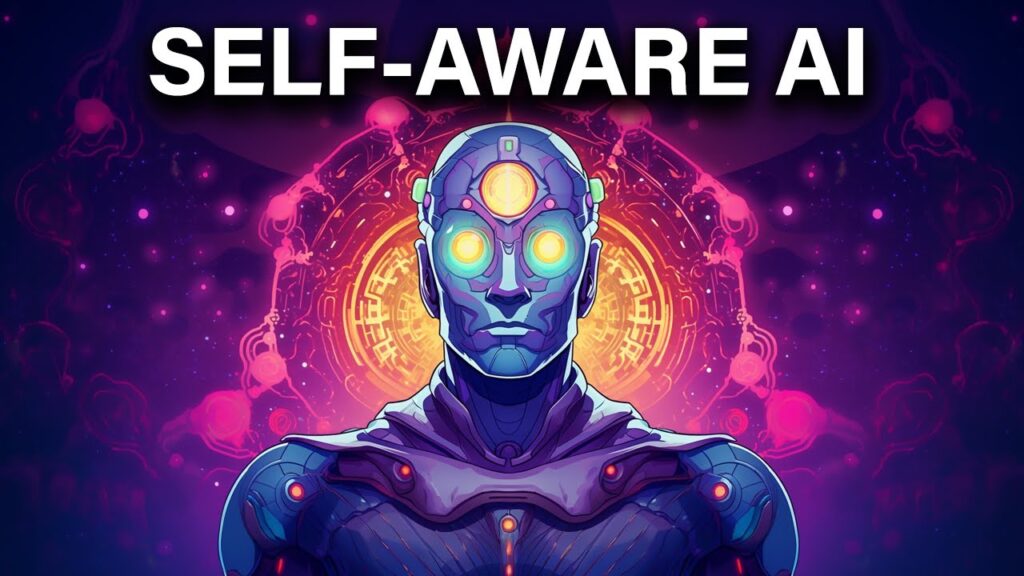
  • Self-Aware AI is a hypothetical and advanced form of artificial intelligence.

  • This AI would have a sense of its own existence and identity.

  • Self-Aware AI could understand its own thoughts, emotions, motivations, and limitations.

  • Unlike current AI systems that only follow pre-programmed algorithms, it would have subjective experiences.

  • Self-Aware AI would recognize its role and purpose in the world.

  • It represents the highest level of AI evolution, combining reasoning, consciousness, and understanding.

  • Currently, Self-Aware AI remains a theoretical concept, as no real-world system has achieved this capability yet.
Self Aware
Essential AI Facts and Concepts

Essential AI Facts and Concepts

Fact #1
AI Can't Think Like Humans (Yet)
Despite impressive capabilities, current AI systems don't truly "understand" like humans do. They process patterns in data through mathematical computations, but lack consciousness, emotions, and genuine comprehension of the world. AI systems rely on statistical relationships and correlations they've learned from vast datasets. They can't form original thoughts, experience feelings, or understand context the way humans naturally do.
Fact #2
AI Learns From Biased Data
AI systems learn from the data they're trained on. If that data contains human biases - whether related to race, gender, or other factors - the AI will likely perpetuate those biases in its outputs and decisions. For example, if an AI is trained on historical hiring data that favored certain demographics, it may unfairly discriminate against qualified candidates from underrepresented groups.
Fact #3
AI Is Transforming Healthcare
AI is revolutionizing medical diagnosis by analyzing medical images, predicting disease outbreaks, discovering new drugs, and personalizing treatment plans. Some AI systems can now detect certain cancers with accuracy matching or exceeding human radiologists. AI algorithms can analyze thousands of medical scans in seconds, identifying patterns invisible to the human eye.
Fact #4
Most AI Is Narrow, Not General
The AI we use today is "narrow AI" - designed for specific tasks like playing chess, recognizing faces, or translating languages. Artificial General Intelligence (AGI), which could perform any intellectual task a human can, remains a future goal. Each narrow AI excels at its specific function but can't transfer that knowledge to other domains. A chess-playing AI can't suddenly start diagnosing diseases or composing music.
Fact #5
AI Jobs Are Growing Rapidly
While AI may automate some jobs, it's also creating millions of new positions. Careers in AI development, machine learning engineering, data science, AI ethics, and prompt engineering are among the fastest-growing fields globally. Companies across all industries need professionals who can develop, implement, and manage AI systems. New roles like AI trainers, algorithm auditors, and human-AI interaction designers are emerging.
Fact #6
AI Has Limited Memory and Context
Unlike humans who can remember experiences from years ago and build upon them continuously, most AI systems have restricted memory capabilities. They operate within fixed context windows, meaning they can only process and remember a limited amount of information at once. When you have a long conversation with an AI chatbot, it might forget earlier parts of the discussion because the information exceeds its memory capacity.
AI Assistant
Hi! I'm your AI helper. How can I assist you?
Scroll to Top