
Welcome Back

Sign in to your account

Create Account

Join us!

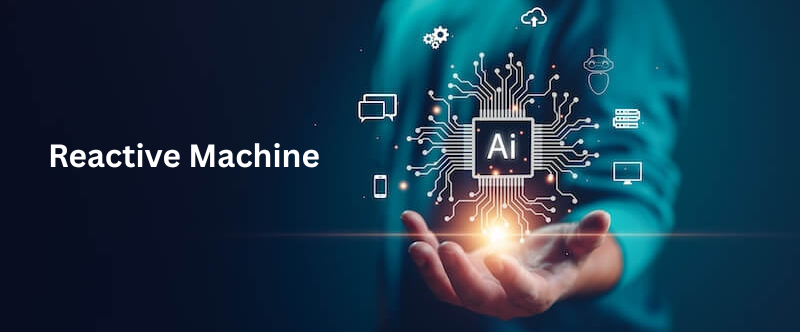
Reactive Machine

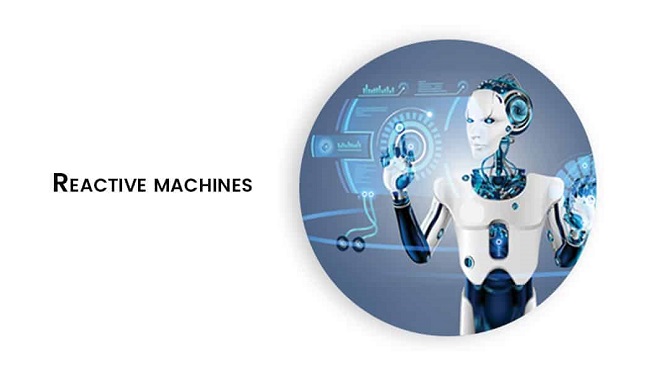
Reactive Machine
  • Reactive machines are the simplest type of artificial intelligence.
  • Function only in the present moment, without memory or learning ability.

  • Operate based on fixed, pre-programmed rules.

  • Do not analyze past data or predict future outcomes.

  • Cannot improve performance through experience.

  • Best suited for specific and repetitive tasks.

  • Lack adaptability to new or unexpected situations.

  • Commonly used in game-playing AI and basic filtering systems.

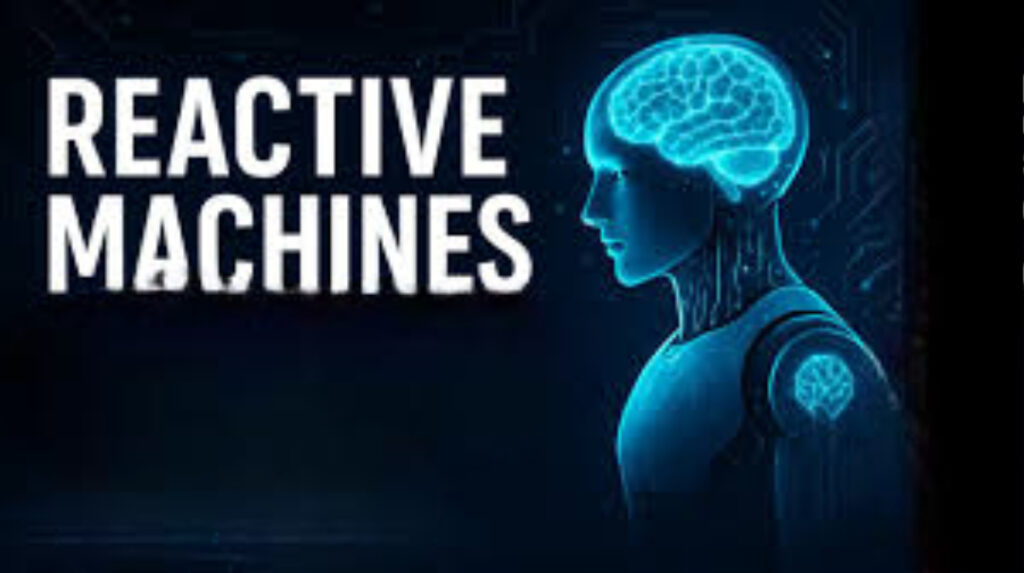
Cyber Circuit Brain
SCAN INPUT SENSE MEMORY CORE LOGIC ACT LINK
  • Reactive machines are the most basic type of AI.

  • Can perform only specific tasks without using memory.

  • Do not learn from past experiences or inform future decisions.

  • Example: Deep Blue, the chess-playing computer.

  • Continuously interact with their environment in real time.

  • Do not maintain an internal representation of the environment.

  • Rely on rules and heuristics for decision-making.

  • Make fast and accurate decisions without large data processing.

  • Commonly used in robot control and autonomous navigation systems.
Reactive Machine
  • Reactive AI systems do not rely on data history or internal models. Instead, they analyze the present input and immediately generate an output based on predefined rules. This makes them extremely fast and reliable in environments where conditions change quickly and decisions must be made in real time.

    Because Reactive AI does not learn from experience, it is easier to design, test, and control. Developers can clearly predict how the system will behave under specific conditions, reducing the risk of unexpected actions. This is one of the main reasons reactive machines are widely used in safety-critical systems.

    Although Reactive AI is limited compared to advanced AI models, it plays a crucial role in many real-world applications. Systems like chess-playing engines, automated traffic signals, and basic recommendation filters rely on reactive behavior to deliver quick and accurate responses without complex computation.
Reactive Machine
6 Smart Facts That Matter in AI

6 Smart Facts That Matter in AI

Fact #1
AI Can't Think Like Humans (Yet)
Despite impressive capabilities, current AI systems don't truly "understand" like humans do. They process patterns in data through mathematical computations, but lack consciousness, emotions, and genuine comprehension of the world. AI systems rely on statistical relationships and correlations they've learned from vast datasets.
Fact #2
Training AI Requires Massive Energy
Training large AI models consumes enormous amounts of electricity - sometimes equivalent to the lifetime energy consumption of several cars. This raises important questions about environmental sustainability and the carbon footprint of AI development. A single training run for advanced models can emit as much carbon as five cars over their entire lifetimes.
Fact #3
AI Learns From Biased Data
AI systems learn from the data they're trained on. If that data contains human biases - whether related to race, gender, or other factors - the AI will likely perpetuate those biases in its outputs and decisions. For example, if an AI is trained on historical hiring data that favored certain demographics, it may unfairly discriminate against qualified candidates from underrepresented groups. Addressing bias requires diverse training data, careful testing, and ongoing monitoring.
Fact #4
AI Is Transforming Healthcare
AI is revolutionizing medical diagnosis by analyzing medical images, predicting disease outbreaks, discovering new drugs, and personalizing treatment plans. Some AI systems can now detect certain cancers with accuracy matching or exceeding human radiologists. AI algorithms can analyze thousands of medical scans in seconds, identifying patterns invisible to the human eye. They're accelerating drug discovery by predicting which molecular compounds might be effective treatments.
Fact #5
Most AI Is Narrow, Not General
The AI we use today is "narrow AI" - designed for specific tasks like playing chess, recognizing faces, or translating languages. Artificial General Intelligence (AGI), which could perform any intellectual task a human can, remains a future goal. Each narrow AI excels at its specific function but can't transfer that knowledge to other domains. A chess-playing AI can't suddenly start diagnosing diseases or composing music.
Fact #6
AI Jobs Are Growing Rapidly
While AI may automate some jobs, it's also creating millions of new positions. Careers in AI development, machine learning engineering, data science, AI ethics, and prompt engineering are among the fastest-growing fields globally. Companies across all industries need professionals who can develop, implement, and manage AI systems. New roles like AI trainers, algorithm auditors, and human-AI interaction designers are emerging.
AI Assistant
Hi! I'm your AI helper. How can I assist you?
Scroll to Top